The Path to Becoming a Go Backend Engineering Master
Go has become a popular choice for backend development due to its simplicity, efficiency, and powerful concurrency support. Whether you're building microservices, cloud-native applications, or high-performance network services, Go excels. Here is a structured learning path to help you gradually improve your skills and ultimately “master” Go.
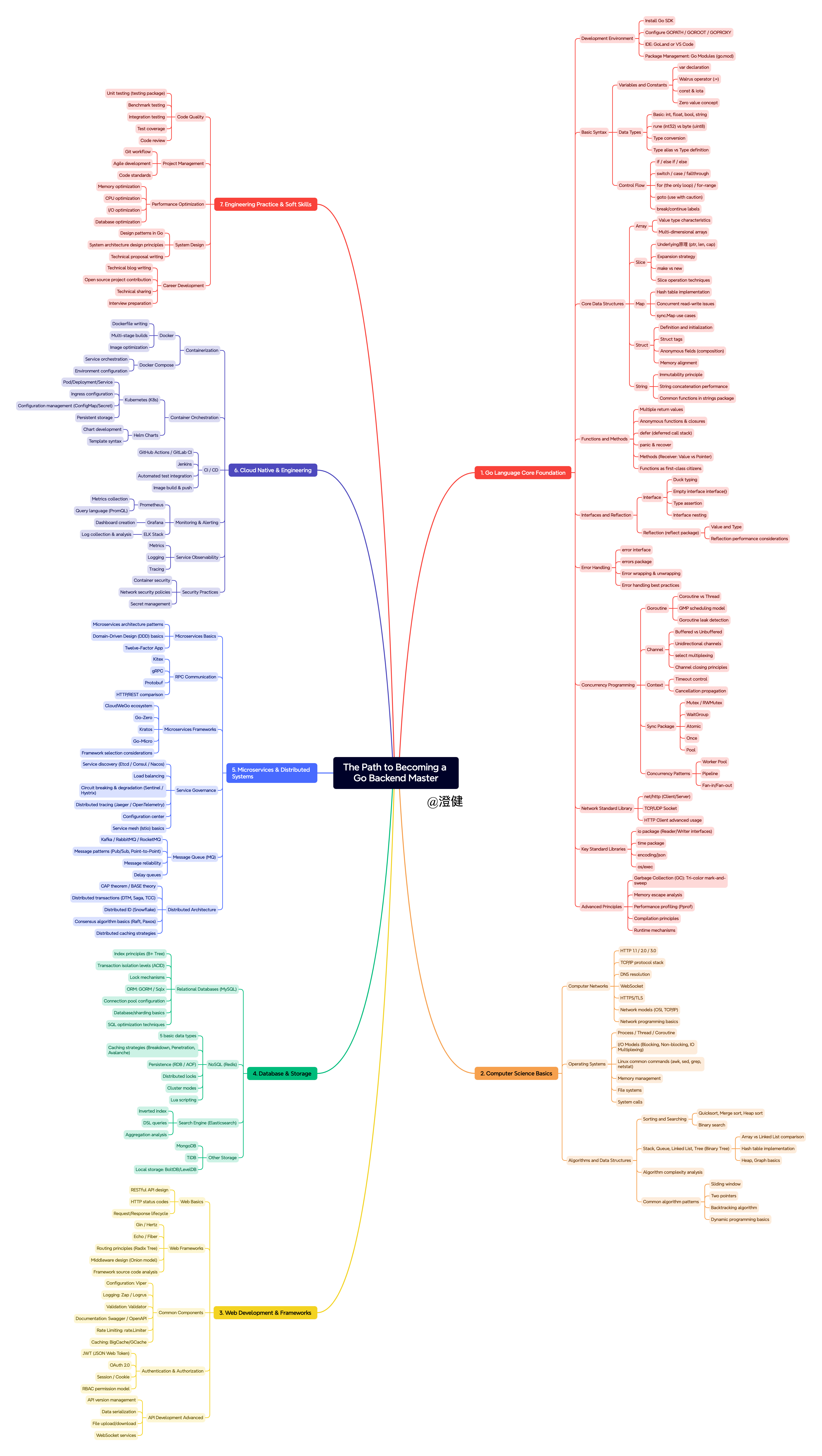
1. Go Language Core Foundation (Foundation)
Learning Go must begin with a solid foundation. Understanding Go’s design philosophy and mastering its core features is the first step toward mastery.
Core Knowledge Points
- Development Environment (SDK): Familiarize yourself with Go SDK,
GOPATH,GOROOT,GOMODULE. - Basic Syntax: Variables, constants, data types (
int,float,string,bool), flow control (if,for,switch). - Object-Oriented: Go is not purely OOP—focus on Structs and Methods.
- Important Features:
- Interfaces: Master empty interfaces (
interface{}/any) and type assertions, and understand Go’s duck typing. - Reflection: Understand
reflect.TypeOfandreflect.ValueOf, often used in frameworks and serialization. - Error Handling: Use the
errorinterface andpanic/recovermechanisms.
- Interfaces: Master empty interfaces (
Go’s charm lies in its simplicity and efficiency. Diving deeper into the following topics will make your code more idiomatic:
- The underlying implementation and expansion mechanism of Slice and Map.
- Understand the philosophy of Zero Value to reduce unnecessary initialization checks.
- Master the execution order and use cases of
defer(e.g., resource cleanup).
Concurrency Programming (Concurrency)
Concurrency is the soul of Go and the foundation of its high performance.
- Goroutine: Lightweight threads that serve as Go’s concurrent execution units.
- Channel: Follow the principle “Do not communicate by sharing memory; instead, share memory by communicating.”
- Master differences between buffered/unbuffered channels.
- Use
selectfor multiplexing.
- Sync Package:
sync.Mutex(lock): Protect shared resources.sync.WaitGroup: Wait for multiple Goroutines to finish.sync.Once: Implement singleton patterns.sync.Mapandsync/atomic.
2. Computer Science Basics (CS Basics)
Backend engineers need more than just a programming language—solid CS fundamentals are essential for solving complex problems.
- Operating Systems (OS):
- Differences and scheduling of processes/threads/coroutines.
- Memory management, virtual memory.
- Linux basics (common commands, file system, I/O model).
- Networking Basics:
- TCP/IP protocol stack: Especially TCP three-way handshake and four-way termination, congestion control.
- HTTP/HTTPS: Version differences (HTTP/1.1, HTTP/2, HTTP/3), status codes, headers.
When your service encounters high concurrency, network latency, or memory leaks, CS fundamentals help you:
- Determine whether the issue lies in the OS, network protocol, or application code.
- Optimize Goroutine scheduling and IO models to build high-performance network services.
3. Web Development & Frameworks (Web Dev)
Go excels in web development thanks to its high performance. Mastering the mainstream frameworks and best practices is key to rapid business delivery.
Popular Frameworks
| Framework Name | Type / Focus | Main Features | Use Cases | Learning Difficulty | Notes |
|---|---|---|---|---|---|
| Gin | Web Framework | Mature ecosystem, largest user base, high performance, lightweight, excellent middleware support | API services, rapid development, small to medium projects | Low | Most active community, default choice for many projects |
| Echo | Web Framework | High performance, extremely clean API design, standard library friendly | RESTful APIs, high-performance web services | Low | Similar to Gin, with slightly different design philosophy |
| Hertz | Web Framework | High performance (based on self-developed Netpoll), open-sourced by ByteDance, integrated with full RPC ecosystem | High-concurrency HTTP APIs, microservice gateways, ByteDance internal tech stack | Medium | Part of the CloudWeGo ecosystem, the official partner for Kitex |
| Fiber | Web Framework | High performance (based on Fasthttp), Express.js-style API, easy migration | High-performance APIs, projects migrating from Node.js Express | Low | Note compatibility issues between Fasthttp and the standard library |
| Iris | Web Framework | Comprehensive features, modular, high performance, rich API | Web applications requiring rich built-in features | Medium | Had early controversies, now stable |
| Beego | Full-Stack Framework | MVC architecture, built-in ORM, Session, caching, logging, and other full suite of components | Full-stack web applications, traditional monolithic applications, enterprise development | Medium | Similar to Python's Django, feature-rich and all-inclusive |
| Revel | Full-Stack Framework | Fully automated, hot reload, zero-configuration startup, convention over configuration | Full-stack web applications, rapid prototyping | Medium | Similar to Java's Play Framework |
| Kitex | RPC/Microservices Framework | High performance, strong extensibility, rich service governance features, supports multiple protocols | Microservices, high-concurrency RPC services, ByteDance internal tech stack | Medium-High | Core component of CloudWeGo, industry benchmark for RPC performance |
| Go-Zero | Microservices Framework | "Tools over conventions", built-in code generation, integrates various microservices components | Microservices architecture, projects requiring rapid CRUD code generation | Medium-High | Provides a one-stop microservices solution |
| Kratos | Microservices Framework | Microservices best practices, API-first, highly pluggable architecture design | Microservices, cloud-native applications | Medium-High | Open-sourced by Bilibili, advanced design理念 |
| GORM | ORM Framework | Most mature ecosystem, full-featured ORM, chainable API, developer-friendly | Projects requiring rapid database operations | Medium | The most widely used ORM among Go developers in China |
| Ent | ORM Framework | Code generation, graph-based queries, type safety, schema as code | Complex data models, graph data operations, high demand for type safety | Medium-High | Open-sourced by Facebook, unique design philosophy |
Core Components & Practices
- Router: Routing groups and middleware development.
- Request & Response:
- Parameter parsing (Query, Path, Form, JSON).
- Unified JSON response format.
- Validation & Authorization:
go-playground/validator: For struct validation.- JWT: Stateless authentication.
- HTTP/HTTPS: Master Go’s built-in
net/http, itsHandlerandServeMuxmechanism.
- Middleware Usage
- RESTful Standards
Use middleware for logging, trace ID, authentication, and CORS, keeping business logic clean.
Follow RESTful API design strictly—proper HTTP methods and status codes.
4. Data Storage & Caching (Database)
Complex backend applications always require data storage.
Relational Databases
- MySQL, PostgreSQL: Focus on SQL optimization, transactions, index principles, stored procedures.
- ORM/Database libraries: Gorm, Xorm, Gorp, sqlx.
- Gorm: Learn model definition, relations, preloading, etc.
NoSQL & Caching
- Redis: The most crucial caching tool.
- Master data structures (String, Hash, List, Set, Sorted Set) and use cases.
- Understand persistence (RDB/AOF) and clustering (Cluster, Sentinel).
- Address cache penetration, avalanche, breakdown.
- MongoDB: Document database.
5. Microservices & Distributed Systems (Microservices)
The mainstream architecture of modern large-scale systems. Go is naturally suited for microservices.
Core Stack
- RPC Frameworks: gRPC—Go’s most popular RPC framework, based on HTTP/2 and Protocol Buffers.
- Service Discovery: Consul, Etcd, Nacos.
- API Gateways: Kong, Zuul, or custom-built.
- Message Queues (MQ): Kafka, RabbitMQ, RocketMQ—for async communication, decoupling, traffic shaping.
Distributed Transactions & Locks
- Distributed Locks: Based on Redis or ZooKeeper.
- Distributed Transactions: Understand TCC, SAGA patterns.
- Tracing: Jaeger/Zipkin/Skywalking for monitoring call chains and performance bottlenecks.
6. Cloud Native & Engineering (Cloud Native)
The final stage of mastery: embracing cloud native and learning modern software delivery pipelines.
Containerization & Orchestration
- Docker: Master Dockerfile, image building, container management.
- Kubernetes (K8s): The OS of the cloud-native era.
- Core Concepts: Pod, Service, Deployment, Volume.
- Master YAML and
kubectl. - Learn Helm for package management.
CI/CD & Engineering
- CI/CD: Jenkins, GitLab CI, GitHub Actions for automated testing, building, and deployment.
- Observability:
- Monitoring: Prometheus (metrics), Grafana (visualization).
- Logging: ELK/Loki stacks.
Cloud native isn’t just Docker and K8s. Its essence is:
- Agility: Fast iteration and deployment.
- Elasticity: Easy scaling for traffic changes.
- High Availability: Automatic recovery.
Mastering these allows you to build highly available and scalable systems.
Summary & Next Steps
The “Go Backend Engineering Mastery Roadmap” is a continuous journey of learning and practicing. Each stage requires real-world projects to solidify your understanding.
| Stage | Core Task | Project Suggestions |
|---|---|---|
| Foundation | Master Go syntax, CS basics, and concurrency. | Build a CLI tool or a multi-goroutine crawler. |
| Web | Master frameworks, databases, caching, API design. | Build a RESTful CRUD blog/forum. |
| Advanced | Master distributed systems, microservices, cloud native tech. | Build a gRPC-based microservice cluster (user/order/payment) and deploy it to K8s. |
Wishing you continuous growth on your Go journey—and ultimately, mastery!